The three interstellar visitors, what Oumuamua, Borisov and 3I/ATLAS taught us
In nine years astronomers went from zero confirmed interstellar objects to three. Here is what each one revealed, and why the pace of discovery matters more than any single visitor.

In 40 words. Since 2017 astronomers have confirmed three objects from outside the solar system passing through, Oumuamua, Borisov and 3I/ATLAS. Each looked different, and together they show interstellar visitors are common, not rare, once you know how to look for them.
For all of human history, everything astronomers tracked in the sky belonged to the solar system. That changed on October 19, 2017, and it has now happened twice more. The gap between the first and the third confirmed interstellar object shrank from decades of theory to eight years of practice, and that acceleration is the real story.
1I/Oumuamua, the one that broke the rule
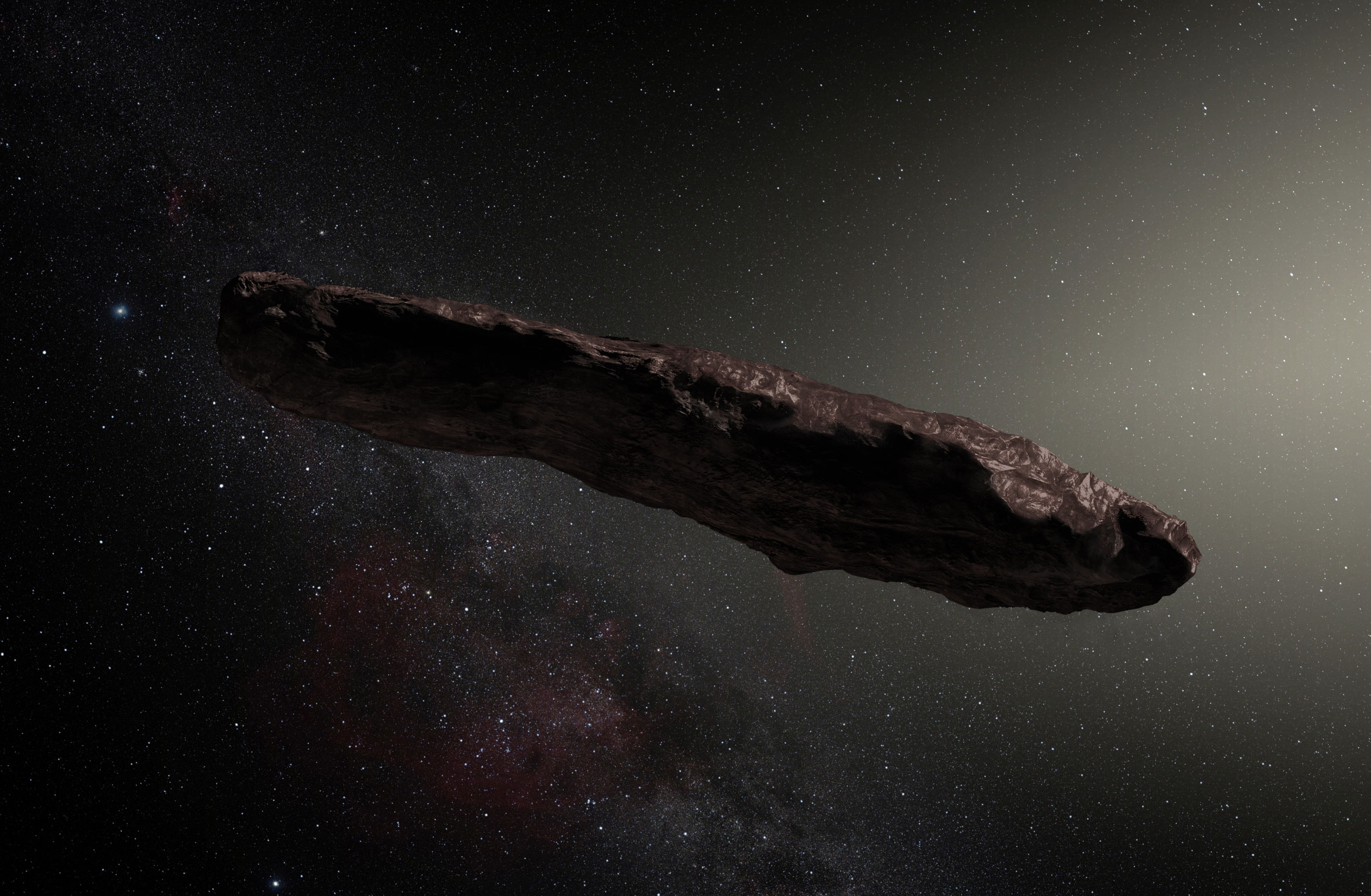
Rob Weryk discovered Oumuamua on October 19, 2017, using the Pan-STARRS1 telescope in Hawaii. Its orbit had an eccentricity of 1.20, the highest ever measured at the time, meaning it was moving too fast for the Sun's gravity to have ever held it. It was gone within weeks of discovery, already leaving the solar system.
Oumuamua was strange from the start. It was highly elongated, perhaps up to 400 meters long and roughly ten times longer than it is wide, based on how sharply its brightness varied as it tumbled. It showed no coma, no tail, none of the gas or dust that comets usually shed near the Sun. Yet it accelerated slightly as it left, a push usually explained by comet outgassing that telescopes never detected. Astronomers still argue about the best explanation, most likely a body shedding hydrogen too faintly to see, but the object was gone before anyone could resolve it.
2I/Borisov, the one that behaved
Not quite two years later, on August 30, 2019, Crimean amateur astronomer Gennady Borisov found the second confirmed interstellar object using a telescope he built himself. Borisov measured about 975 meters across, more than double Oumuamua's size, and it traveled at roughly 177,000 kilometers per hour.
Where Oumuamua puzzled scientists by acting like nothing familiar, Borisov reassured them by acting exactly like a comet from our own backyard. It had a visible coma and tail, and Hubble and ALMA observations found an unusually high ratio of carbon monoxide to water, a twist that told astronomers Borisov likely formed near a cold red dwarf star, far from its sun, at a temperature that let carbon monoxide freeze into the nucleus.
The sky never sleeps.
Eclipses, meteor showers, launches… Every Sunday I send you the week’s sky events you can’t miss. Free.
3I/ATLAS, the largest and fastest yet
The third confirmed visitor was discovered on July 1, 2025, spotted by the NASA-funded ATLAS survey telescope in Rio Hurtado, Chile. 3I/ATLAS dwarfed its predecessors, with a nucleus somewhere between 440 meters and 5.6 kilometers across, and it entered the solar system faster than either Oumuamua or Borisov, at about 221,000 kilometers per hour, climbing to 246,000 kilometers per hour at its closest approach to the Sun on October 30, 2025. It came no closer to Earth than 270 million kilometers, on December 19, 2025, never posing any danger to the planet.
James Webb Space Telescope observations found 3I/ATLAS unusually rich in carbon dioxide relative to water, with a CO2 to water ratio of about 7.6, among the highest such ratios ever measured in any comet, hinting it formed in a colder or more irradiated environment than solar system comets typically did. A follow up study published in Nature in June 2026 estimated the comet's ices could be more than 10 billion years old, older than the solar system itself, making 3I/ATLAS a fragment of one of the galaxy's oldest surviving building blocks. Unsurprisingly, an object that strange also attracted wild claims that it was an alien probe, the same kind of leap that turned an unrelated eclipse date into a fake gravity hoax earlier this month, and no evidence supports it.
Why three in nine years is not a coincidence
Oumuamua was found by luck, with survey telescopes not yet tuned to catch objects on hyperbolic paths. Borisov's discoverer built his own gear specifically hunting for one. By the time 3I/ATLAS arrived, the ATLAS network was scanning the sky nightly and flagged it within days. The next generation instrument, the Vera C. Rubin Observatory, is now online and expected to spot interstellar objects far more often, with estimates ranging from about five to several dozen a year once it reaches full survey speed.
Three objects is not enough to say what is typical out there. It is enough to say these visitors are not once in a lifetime events, they are a population that better telescopes will keep finding, one strange world at a time.
Frequently asked questions
How many confirmed interstellar objects have been found?
Three as of August 2026, Oumuamua in 2017, Borisov in 2019 and 3I/ATLAS in 2025. Astronomers expect that number to grow quickly as new survey telescopes like Vera C. Rubin come online.
Was 3I/ATLAS ever a threat to Earth?
No. Its closest approach to Earth was about 270 million kilometers on December 19, 2025, roughly 1.8 times the Earth-Sun distance, far too far to pose any risk.
Why did Oumuamua accelerate without showing a comet tail?
Astronomers have not settled on a single answer. The leading explanation is outgassing of hydrogen or another volatile too faint for telescopes to detect, though the object left the solar system before it could be studied further.
Which interstellar object is the oldest?
3I/ATLAS. A June 2026 study in Nature estimated its ices may be more than 10 billion years old, making it older than the Sun and the solar system.
Sources
- NASA, Rob Weryk and the discovery of Oumuamua
- NASA JPL Small-Body Database, orbital elements of 1I/Oumuamua
- NASA Science, Oumuamua facts
- NASA Science, 2I/Borisov facts
- NASA Science, interstellar comet Borisov reveals its chemistry and possible origins
- NASA Science, 3I/ATLAS facts and FAQs
- Phys.org, JWST reveals 3I/ATLAS's coma is largely carbon dioxide
- NASA Science, Webb finds clues to ancient, distant origin of comet 3I/ATLAS
- Phys.org, Vera Rubin Observatory should find five interstellar objects a year
The sky never sleeps.
Eclipses, meteor showers, launches… Every Sunday I send you the week’s sky events you can’t miss. Free.